The https://finanzasdomesticas.com/plan-de-estimulo-joe-biden-aprobado marked one of the largest economic relief packages in recent US history. Its main objective was to accelerate the economic recovery following the pandemic, support families, businesses, state and local governments, and strengthen the healthcare and education systems.
Even though all people might recollect is simply checks to pay, billions of dollars went to sectors as well. Over the years, economists and business leaders in Washington conducted an examination of its results on growth and costs, in addition to the number of additional key signs of business health– jobs and the amount the business can expand.
Quick Summary
| Aspect |
Information |
| Official name |
American Rescue Plan Act (ARPA) |
| Approval |
March 2021 |
| Approximate value |
$1.9 trillion |
| President |
Joe Biden |
| Aim |
Economic recovery after the pandemic |
| Beneficiaries |
Families, businesses, schools, hospitals, and local governments |
What Was the Stimulus Plan?
The https://finanzasdomesticas.com/plan-de-estimulo-joe-biden-aprobado was designed to boost recovery. The Joe Biden stimulus plan that was approved was designed to address the economic consequences of the COVID-19 pandemic.
It wasn’t just about giving money directly to citizens. It also sought to strengthen critical areas such as:
- Public health
- Education
- labor market
- Vaccination
- Support for small businesses
- State and municipal governments
- Food programs
The strategy involves a boost in consumption; retaining jobs, and not a slow paced recovery to stimulate the economy.
Why Was It Necessary?
During 2020 the US economy experienced:
- Business closures
- Millions of jobs lost
- Drop in consumption
- Decrease in tourism
- Supply chain problems
- Financial uncertainty
Although previous programs existed during the Trump administration, the new administration deemed an additional package necessary to consolidate the recovery.
Main Components of the Program
1. Direct Checks
Millions of Americans received direct payments.
| Concept |
Amount |
| Payment per eligible adult |
1.400 USD |
| Dependents |
They also qualified |
| Distribution |
Bank deposit or check |
These payments were intended to stimulate immediate consumption.
2. Unemployment Benefits
Benefits for unemployed workers were temporarily extended.
The objectives were:
- avoid a drop in family income;
- sustain domestic consumption;
- reduce the economic impact of the closures.
3. Tax Credits for Families
One of the most important changes was the expansion of the Child Tax Credit. This allowed many families to receive monthly payments during part of 2021.
4. Support for Schools
Billions of dollars were allocated to:
- safe reopening;
- ventilation;
- technological equipment;
- staff recruitment;
- learning recovery.
5. Funds for Vaccination
Resources were allocated for:
| Area |
Aim |
| Vaccines |
National distribution |
| Medical centers |
Greater capacity |
| COVID tests |
Increase availability |
| Public health |
Improve healthcare response |
6. Aid for State Governments
Many states faced significant budget deficits.
The resources helped to maintain:
- police;
- firefighters;
- teachers;
- public services;
- hospitals.
Economic Impact
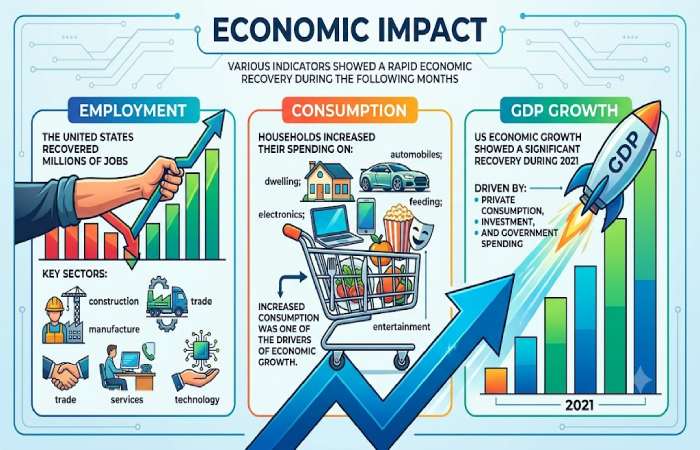
Various indicators showed a rapid economic recovery during the following months.
Employment
The United States recovered millions of jobs.
Key sectors:
- construction;
- manufacture;
- trade;
- services;
- technology.
Consumption
Households increased their spending on:
- dwelling;
- automobiles;
- electronics;
- feeding;
- entertainment.
Increased consumption was one of the drivers of economic growth.
GDP growth
US economic growth showed a significant recovery during 2021, driven by private consumption, investment, and government spending.
Benefits for Small Businesses
Many small businesses continued to face financial problems.
The package included aid through:
- grants;
- loans;
- special programs;
- community assistance.
This allowed operations to continue and jobs to be preserved.
Sectors that Benefit Most
| Sector |
Benefit |
| Health |
Greater investment |
| Education |
Resources for reopening |
| Restaurants |
Financial support |
| Transport |
Recovery funds |
| Local governments |
Budgetary stability |
| Tourism |
Aid programs |
Who Received the Checks?
Eligibility depended primarily on declared income.
They generally rated:
- US citizens;
- eligible permanent residents;
- families with children;
- taxpayers with income within the established limits.
Criticisms of the Program
Although many economists supported the initiative, criticism also arose. The main ones were:
Inflation
Some experts argue that the increase in public spending contributed to the inflationary pressures observed between 2021 and 2022.
Tax Deficit
The high cost increased the federal budget deficit.
Overstimulation
Other analysts believe that the recovery was already underway and that some of the spending may have been greater than necessary.
Arguments in Favor
Proponents of the program point out that:
- It prevented a slow recovery;
- temporarily reduced child poverty;
- strengthened the labor market;
- supported hospitals;
- boosted consumption;
- accelerated vaccination.
Comparison with Previous Stimuli
| Feature |
CARES Act |
American Rescue Plan |
| Year |
2020 |
2021 |
| President |
Donald Trump |
Joe Biden |
| Value |
2.2 trillion USD |
1.9 trillion USD |
| Direct payment |
Yeah |
Yeah |
| Educational support |
High |
Very high |
| Child loan |
Limited |
Expanded |
Effects on Markets
Financial markets reacted positively in the following months due to:
- higher growth expectations;
- increased consumption;
- business recovery;
- increase in corporate profits.
However, concerns related to inflation and interest rates also subsequently arose.
Economic Lessons
The program provided several lessons for future crises:
- Speed in government response is essential.
- Direct support to households can boost consumption.
- Investment in health strengthens economic recovery.
- Coordination between governments facilitates implementation.
- Aid must be balanced with fiscal stability.
International Impact
Although it was a US policy, its effects reached other countries.
Among them:
- increased imports;
- recovery of international trade;
- increased demand for raw materials;
- strengthening global financial markets.
Future Perspectives
The debate surrounding https://finanzasdomesticas.com/plan-de-estimulo-joe-biden-aprobado remains relevant. Its outcome influences how governments and international organizations design responses to future recessions or emergencies.
Analysts agree that the experience offers valuable information on how to balance immediate economic support with fiscal sustainability and inflation control.
Frequently Asked Questions
When was it approved?
It was approved in March 2021.
What was its value?
Approximately $1.9 trillion.
Did it include checks for citizens?
Yes. Many eligible citizens received direct payments of up to $1,400 per person.
Did it only benefit families?
No. He also supported businesses, hospitals, schools, state governments, and public health programs.
Did it generate inflation?
There is considerable debate among economists. Some believe it contributed partially to the rise in inflation, while others point out that global factors, such as supply chain disruptions and increased energy prices, also played a significant role.
Conclusion
The https://finanzasdomesticas.com/plan-de-estimulo-joe-biden-aprobado represented a massive fiscal response to address an unprecedented economic crisis. Beyond direct payments to citizens, the program strengthened essential sectors such as healthcare, education, and the labor market, contributing to a faster recovery of economic activity.
At the same time, it sparked a debate about the balance between growth driven by public spending and the risks associated with rising inflation and fiscal deficits. His legacy continues to be studied by economists and policymakers, becoming a benchmark for designing future economic stimulus measures in response to national or global crises.