If you’re planning a wildlife photography holiday in India, two destinations will almost certainly appear at the top of your list—Jim Corbett National Park in Uttarakhand and Ranthambore National Park in Rajasthan. Both are among the country’s most famous tiger reserves, attracting thousands of photographers and nature enthusiasts every year. However, they offer very different experiences, especially for travelers with a fixed budget and limited time.
Choosing between Corbett and Ranthambore for a 5-day photography trip in November within a budget of 50K. Corbett and Ranthambore have their respective pros and cons when it comes to Tiger photography. However, there are more important factors that come into play when deciding between the two for a photography holiday, such as what type of landscape photography you aim for and which other flora and fauna you want to capture besides the elusive tiger. Ultimately, the Value for Money is also a key factor in deciding.
Corbett vs Ranthambore at a Glance
Before diving into the details, here’s a quick comparison of the two parks.
| Feature |
Corbett National Park |
Ranthambore National Park |
| State |
Uttarakhand |
Rajasthan |
| Best Known For |
Biodiversity, elephants, birds |
Tiger sightings |
| Best Time to Visit |
November–April |
October–April |
| Photography Style |
Wildlife diversity & landscapes |
Tiger portraits |
| Difficulty Level |
Moderate |
Beginner-friendly |
| Bird Species |
600+ |
Around 300 |
| Landscape |
Rivers, forests, grasslands |
Lakes, ruins, dry forests |
| Suitable for ₹50K Budget |
Yes |
Yes |
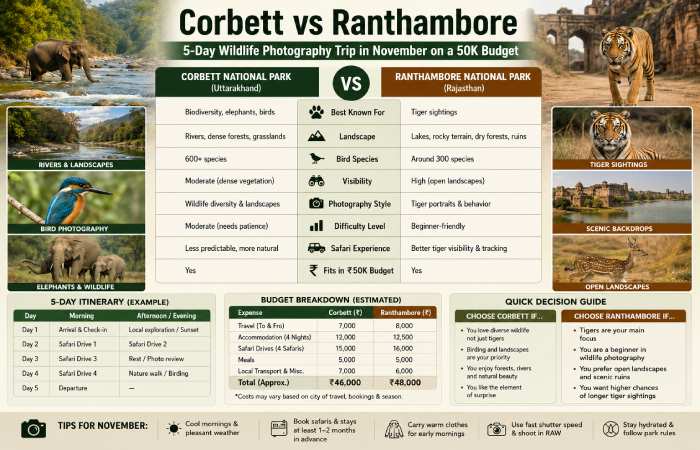
While both the sites are Tiger Reserves, their environment differ greatly. From dense forests, river valleys, and foothills of the Himalayas in Corbett to open woodland, rocks, and ruins of a fort in Ranthambore, their surroundings influence the tiger photography aspect directly.
Wildlife Photography Experience
Whether it is a park, forest, or mountain range, a photographer’s success is judged according to image outputs rather than solely how many animals they can identify. With this in mind, a park that has changeable light conditions, aesthetically pleasing backdrops, plus appealing animal behaviors in action will often contribute much better to the overall portfolio of wildlife photographs.
Corbett National Park
The oldest national park of India, Corbett is also considered the most biodiverse national park of India. The dense Sal forests, grasslands, and rivers are backed by the backdrop of hills, providing some never-ending photographic opportunities. Every safari feels new, as the changing terrain poses for some ever-varying frames.
Other animals in Corbett: Along with Bengal tigers in Corbett, there are Asian elephants, leopards, otters, crocodiles, deer, sambar (elk), barking deer, wild boar, and many hundreds of bird species here. Corbett is such a diverse area for photographers.
“The biggest problem is with the visibility,” the guide stated. “The animals hide inside the dense flora,” therefore the photographers should be able to capture the animals as and when they come out in the open, by managing the speed of the camera and a lot of patience and, in the end, a lot of luck. “To get even a tiger here needs that.”
Ranthambore National Park
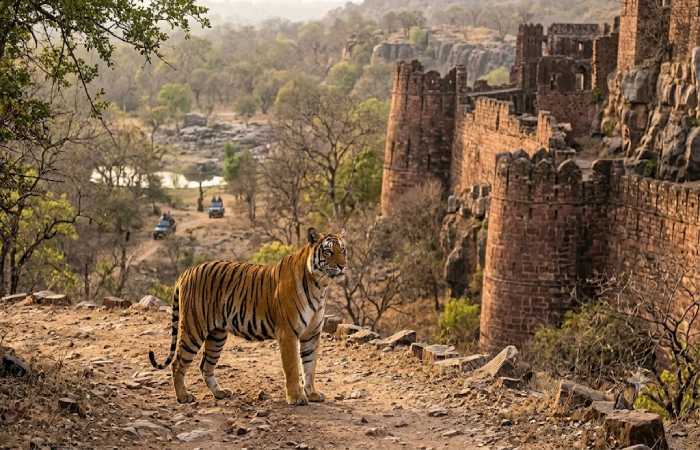
We highly advise people new to wildlife photography to visit Ranthambore because it’s a significantly flatter terrain. Animals are easily visible, and most times photographer will find the time to get their shots at leisure before the animal is gone.
This park has made a name for itself as the safaris and regulated tourism have made most of the animals very comfortable in the company of jeep vehicles. They often walk across a forest path or simply stretch their body next to a water body. It offers a great chance to capture tigers against a natural backdrop in India.
Which Park Offers Better Tiger Photography?
If tigers are at the very top of your wish list, Ranthambore will probably score highest. Due to the more open nature of the park, guides are better able to predict movements, therefore offering longer sessions to shoot the animals; often a golden period for tigers, which photographers will want to use for portraits, animal interaction or behavioral shoots.
There is also a reasonable tiger population in Corbett, but these viewings tend to be short because, due to dense forest, most species have good cover in this area, so they can prove to be elusive for a photographer who requires time to frame his shot perfectly.
Tiger Photography Comparison
| Feature |
Corbett |
Ranthambore |
| Tiger Visibility |
Moderate |
High |
| Habitat |
Dense Forest |
Open Woodland |
| Portrait Opportunities |
Good |
Excellent |
| Beginner Friendly |
Moderate |
Yes |
| Average Viewing Time |
Short |
Longer |
| Best Choice |
Wildlife storytelling |
Tiger-focused photography |
Bird and Landscape Photography
While Ranthambore is celebrated for big cats, Corbett is a paradise for bird photographers. More than 600 bird species have been recorded here, including kingfishers, hornbills, eagles, woodpeckers, and migratory birds that arrive during winter.
The rivers flowing through Corbett also create opportunities to photograph crocodiles, elephants crossing water, and birds hunting along the riverbanks. Morning mist adds depth and atmosphere to landscape images, making November an especially rewarding time to visit.
Can You Complete the Trip Within ₹50,000?
The answer is yes—provided you book in advance and choose mid-range accommodation instead of luxury resorts. A ₹50,000 budget is generally sufficient for transportation, four safari drives, hotel stays, meals, and local travel in either destination.
| Expense |
Corbett (₹) |
Ranthambore (₹) |
| Travel |
7,000 |
8,000 |
| Hotel (4 Nights) |
12,000 |
12,500 |
| Safari Drives |
15,000 |
16,000 |
| Meals |
5,000 |
5,000 |
| Local Transport & Misc. |
7,000 |
6,500 |
| Estimated Total |
46,000 |
48,000 |
The remaining budget can be used for photography accessories, guide tips, or emergency expenses.
Suggested 5-Day Wildlife Photography Itinerary
A well-planned itinerary can make a significant difference to the quality of your photographs. Instead of trying to fit in as many activities as possible, dedicate most of your time to safari drives. Wildlife photography rewards patience, and multiple safaris increase your chances of observing different species and behaviors under changing light conditions.
| Day |
Activity |
Photography Focus |
| Day 1 |
Arrival and hotel check-in |
Landscape and sunset photography |
| Day 2 |
Morning & afternoon safari |
Tigers, deer, birds |
| Day 3 |
Morning safari and leisure |
Wildlife behavior and landscapes |
| Day 4 |
Morning & afternoon safari |
Best chance for tiger sightings |
| Day 5 |
Departure |
Scenic travel photography |
Whether you choose Corbett or Ranthambore, avoid booking only one safari. Wildlife sightings are unpredictable, and each drive offers different lighting conditions and animal activity.
Photography Tips for November Safaris
November provides some of the best natural lighting conditions for wildlife photography in India. Early mornings are cool, skies are generally clear, and the soft sunlight enhances colors without creating harsh shadows.
If you’re planning to compare Corbett and Ranthambore for a 5 day wildlife photography trip in November on a 50K budget, carrying the right camera gear is just as important as selecting the right destination. A DSLR or mirrorless camera paired with a telephoto lens between 100–500 mm or 150–600 mm is ideal for wildlife. A standard zoom lens is also useful for capturing landscapes, safari moments, and the surrounding environment.
November Weather
| Factor |
Corbett |
Ranthambore |
| Morning Temperature |
8–15°C |
10–16°C |
| Afternoon |
Pleasant |
Warm |
| Rain |
Low |
Very Low |
| Photography Light |
Excellent |
Excellent |
November is among the best months for wildlife photography in both parks due to comfortable temperatures and good natural light.
Best Camera Equipment
Recommended gear:
| Equipment |
Recommendation |
| Camera |
Mirrorless or DSLR |
| Wildlife Lens |
100–500mm or 150–600mm |
| Backup Lens |
24–70mm |
| Memory Cards |
Multiple high-speed cards |
| Batteries |
Minimum three |
| Bean Bag |
Highly recommended |
| Rain Cover |
Useful for Corbett |
Photography Tips
- Shoot during early morning golden light.
- Keep shutter speed above 1/1600 sec for moving animals.
- Use continuous autofocus.
- Avoid excessive cropping.
- Shoot in RAW.
- Keep ISO flexible rather than compromising shutter speed.
- Respect animal behavior and maintain silence.
Pros and Cons of Each Destination
Both parks have distinct strengths, and understanding their advantages can help you make an informed decision.
Corbett National Park
Pros
- Exceptional biodiversity with elephants, birds, reptiles, and big cats.
- Beautiful rivers, forests, and mountain landscapes.
- Excellent destination for bird and landscape photography.
- Less commercial atmosphere in many zones.
Cons
- Dense vegetation makes wildlife harder to spot.
- Tiger sightings are generally shorter and less predictable.
- Requires more patience and experience for successful photography.
Ranthambore National Park
Pros
- Higher probability of tiger sightings.
- Open landscapes allow cleaner compositions.
- Easier for beginners to photograph wildlife.
- Historic fort, lakes, and rocky terrain add dramatic backgrounds.
Cons
- Popular safari zones can become busy during peak season.
- Greater visitor numbers may reduce the feeling of wilderness compared with Corbett.
Tiger Sighting Comparison
| Category |
Corbett |
Ranthambore |
| Tiger Density |
Good |
Very High |
| Visibility |
Lower |
Higher |
| Open Habitat |
Limited |
Excellent |
| Close Encounters |
Less frequent |
Common |
| Ideal For Tiger Beginners |
Moderate |
Excellent |
If your primary goal is tiger portraits, Ranthambore usually has an advantage.
Which National Park Should You Choose?
If your main objective is photographing Bengal tigers, Ranthambore is usually the stronger choice. Its open habitat gives photographers more time to compose images, experiment with framing, and capture natural behavior. Beginners often return with more successful tiger photographs simply because visibility is better.
However, wildlife photography is about much more than a single species. Corbett offers richer biodiversity, changing landscapes, and opportunities to photograph birds, elephants, crocodiles, and river ecosystems. Every safari feels unique, making it an excellent destination for photographers who enjoy documenting complete ecosystems rather than chasing only tiger sightings.
When travelers compare Corbett and Ranthambore for a 5 day wildlife photography trip in November on a 50K budget, there is no universal winner. The better destination depends on the kind of portfolio you want to build. Ranthambore excels at iconic tiger photography, while Corbett rewards photographers interested in diversity, landscapes, and storytelling.
Final Verdict
Choosing between Corbett and Ranthambore doesn’t have to be difficult once you define your priorities. Both parks comfortably fit within a ₹50,000 budget and offer outstanding wildlife experiences during November, but they appeal to different types of photographers.
Corbett Vs Ranthambore – Which one for a 5 Day Wildlife Photography Trip in November on a 50K budget? If it’s a five-day wildlife photography trip and your eye is on spotting a tiger, and money is also a factor within 50 K in India, then Ranthambore can be a win-win for your Tiger photography, while Corbett does offer a comprehensive wildlife experience and is not just focused on one animal. But either way, the time spent out on safari, planning, and early bookings will mean much more than luxury amenities when it comes to your photography.