Spain’s economic recovery has progressed steadily since the pandemic, but many analysts agree that achieving sustainable growth and consolidating Gross Domestic Product (GDP) will take more time. In this article, we analyze what it means that https://finanzasdomesticas.com/espana-tardara-mas-en-recuperar-su-pib, and what the facts are.
What does it mean to recover GDP?
Gross Domestic Product (GDP) represents the total value of all goods and services produced in a country during a period of time.
However, recovering GDP doesn’t just mean returning to pre-crisis levels. It also means that
- Generate and
- Incrementar la productividad.
- Improve purchasing power.
- Favorecer la inversión.
- Maintain a
In other words, an economy
Why will it take Spain longer to recover its GDP?
Several factors explain this situation.
1. More moderate economic growth
Although Spain is a country with one of the best growth rates in the Eurozone, its performance is now slowing in comparison with the growth we observed in the post-COVID years. Domestic demand will remain the major contribution to the growth, whereas in the case of trade, results have been more unstable.
2. Lower productivity
One of the pr
Many sectors generate employment, but produce less added value per worker compared to other European economies.
Among the causes, the following stand out:
- Small businesses.
- Low technological investment.
- Limited innovation.
- Limited investment in R&D.
Without improvements in productivity, it becomes more difficult to maintain high growth over long periods.
3. Dependence on tourism
Spain continues to be a tourist powerhouse.
Although tourism contributes billions of euros each year, over-reliance on a single sector makes the economy more vulnerable to:
- Health crises.
- Climate change.
- International conflicts.
- Reduction of consumption.
Diversifying the economy remains one of the main challenges.
Main factors that delay recovery
| Factor |
Impact on GDP |
| Inflation |
Reduce household consumption |
| High interest rates |
Business investment decreases |
| Lower European demand |
Exports decrease |
| Low productivity |
It limits economic growth. |
| International uncertainty |
It delays investments |
| Public deficit |
It reduces the government’s room for maneuver. |
How inflation affects
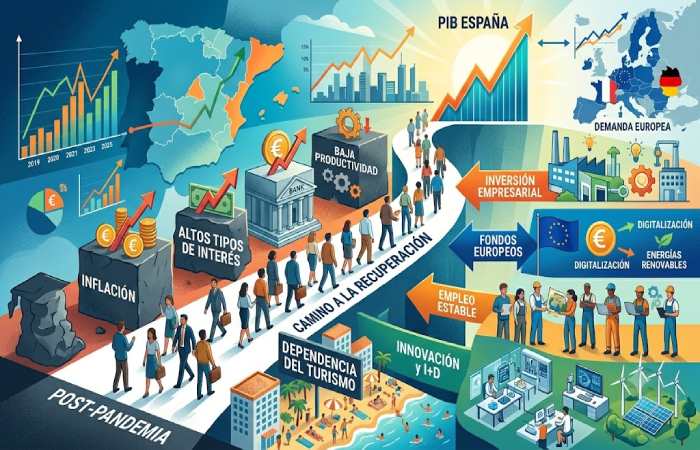
Inflation directly impacts the economy.
When prices increase:
- Families are buying less.
- Companies are reducing investments.
- Production costs are increasing.
- Growth is slowing down.
Although inflation has moderated from its recent highs, it continues to influence consumption and investment decisions.
Business investment remains key
Private investment drives:
- New factories.
- Innovation.
- Technology.
- Employment.
- Exports.
When companies delay investments due to economic uncertainty or high financial costs, GDP growth also loses momentum.
What about employment?
Spain has managed to significantly improve its labor market in recent years.
Positive aspects:
- More people affiliated with Social Security.
- Increased permanent hiring.
- Gradual decline in unemployment.
However, significant challenges remain:
- Low labor productivity.
- Youth unemployment.
- Regional differences.
- Shortage of skilled workers.
Job growth alone does not guarantee a sustainable increase in GDP.
Recent evolution of some indicators
| Indicator |
Trend |
| GDP growth |
Positive but slower |
| Inflation |
Moderating |
| Employment |
It continues to grow |
| Exports |
Irregular growth |
| Private consumption |
More moderate |
| Investment |
Gradual recovery |
The role of Europe
Spain is considerably dependent on the European economic evolution.
The main trading partners are:
- France
- Germany
- Italy
- Portugal
When these economies slow their growth:
- Exports are down.
- Less is being invested.
- External demand is down.
For this reason, the Spanish recovery is also conditioned by the international context.
European funds and economic transformation
European funds represent an opportunity to accelerate the recovery through investments in:
- Digitization.
- Renewable energies.
- Infrastructure.
- Vocational training.
- Technological innovation.
Its impact will depend on the speed and efficiency with which the projects are executed.
Sectors with the greatest potential
Some sectors can drive future growth.
| Sector |
Perspective |
| Renewable energies |
Very high |
| Technology |
High |
| Artificial intelligence |
Growing |
| Advanced Industry |
Positive |
| Health |
Stable |
| Tourism |
It remains strategic |
What do the experts think?
Several economic institutions believe that Spain will continue to grow, albeit at a more moderate pace than in the years immediately following the pandemic. Domestic demand continues to support economic activity, while international uncertainty, inflation, and investment are shaping the outlook for the coming years.
Can Spain accelerate its recovery?
Yes, although it will depend on several factors.
Among the measures that could promote stronger growth are:
- Increase productivity.
- Promote innovation.
- Facilitate private investment.
- Reduce administrative barriers.
- Improve job training.
- To favor technology companies.
- Increase international competitiveness.
What can businesses and families do?
Although economic growth depends on multiple factors, there are individual decisions that help to adapt better.
For families
- Save regularly.
- Avoid over-indebtedness.
- Diversify investments.
- Improve financial education.
For companies
- Digitize processes.
- Invest in innovation.
- Diversify markets.
- Train the workers.
The importance of sound finances
One positive aspect is that household and business debt, measured as a percentage of GDP, is at historically low levels, which improves the financial resilience of the Spanish economy.
However, the sustainability of growth will also depend on maintaining balanced public finances and continuing to promote productive investment.
Frequently Asked Questions
Why is Spain taking longer to recover its GDP?
Because economic growth faces factors such as inflation, lower productivity, international uncertainty, and more moderate business investment.
Which sectors will drive growth?
Renewable energy, technology, digitalization, health, and advanced industry appear among the sectors with the greatest potential.
Does Europe influence the Spanish economy?
Yes. The economic performance of Spain’s main European trading partners directly affects its exports, investment, and economic growth.
Can the situation improve?
Yes. If productivity, innovation, and investment increase, growth could consolidate over the next few years.
Conclusion
The scenario described in https://finanzasdomesticas.com/espana-tardara-mas-en-recuperar-su-pib reflects a complex reality: Spain maintains growth potential, but a full GDP recovery requires time and structural reforms. The combination of productivity, innovation, investment, and macroeconomic stability will be crucial to sustaining economic progress. For citizens, businesses, and public officials, understanding these factors allows for more informed decision-making in an environment that will continue to evolve in the coming years.